

The Science of Soil: Why Getting Your Hands Dirty Calms Your Mind
There is a specific kind of tired that comes from a day spent entirely on screens — not the good tired of a body that has worked, but a restless, wired exhaustion that follows you to bed. Many Atlanta residents know it well.
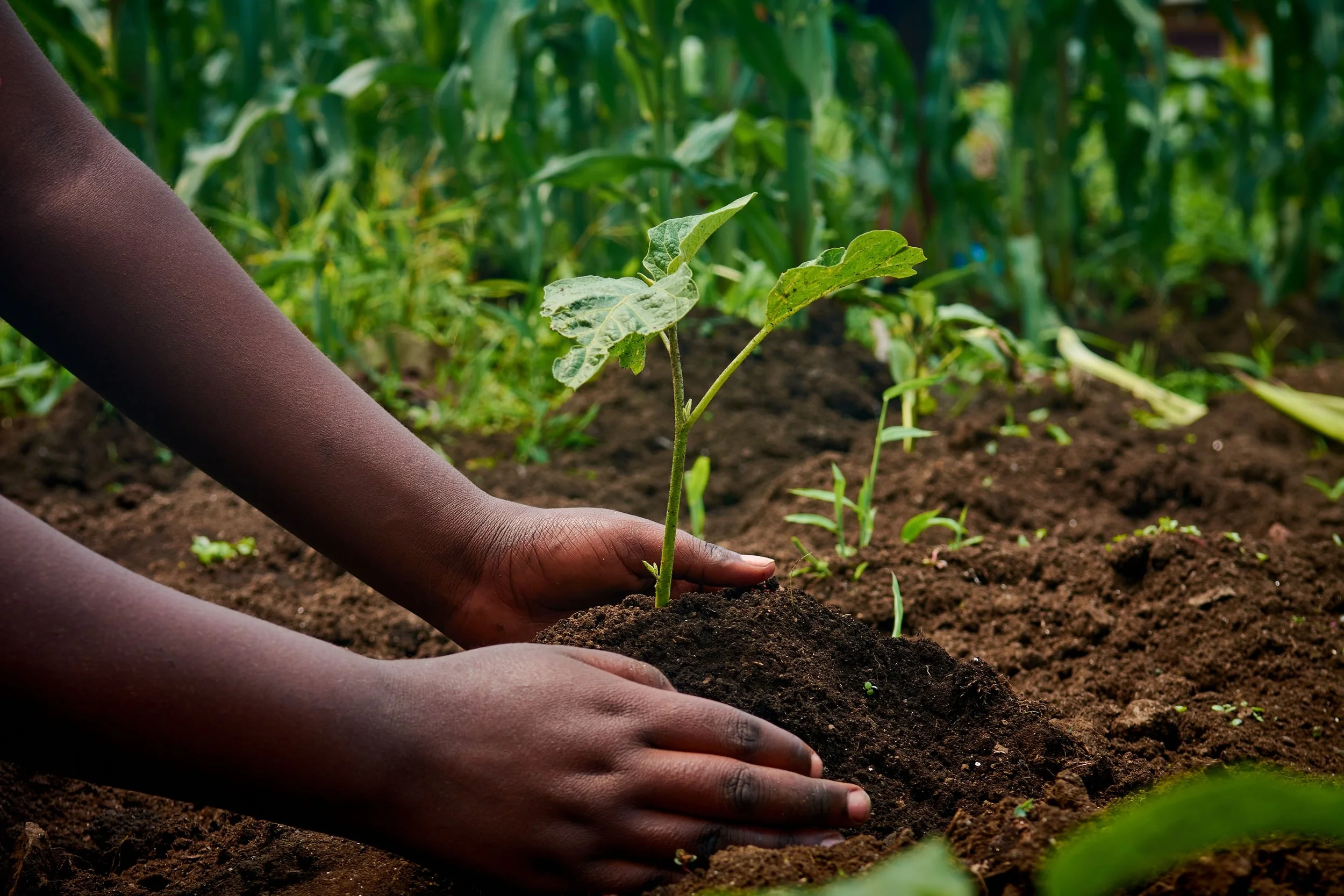
Then you spend forty minutes turning compost into a bed in your backyard, and something shifts.
Gardeners have described that shift for centuries in vague terms: it's peaceful, it's grounding, it clears my head. What's changed recently is that researchers have started identifying the mechanisms — and one surprising finding is that part of the effect may come from the soil itself. The living, microbially dense material under your fingernails.
Here's what the science says, what it doesn't, and how to build an Atlanta kitchen garden that delivers the benefit instead of engineering it out.
Meet Mycobacterium vaccae, the Soil Bacterium Behind the Calm
The bacterium at the center of this research is Mycobacterium vaccae (pronounced "em vah-kay"), identified in soil along the shores of Lake Kyoga in Uganda, where local residents responded unusually well to tuberculosis vaccination. The soil organism appeared to have immune-regulating properties that improved how the vaccines worked.
The mental health connection surfaced almost by accident. In a trial where lung cancer patients were injected with the bacterium, they didn't live longer — but their mood improved. That oddity caught the attention of neuroscientist Christopher Lowry, then at the University of Bristol. In mice, he and his colleagues identified a small group of serotonin-containing neurons activated by M. vaccae, and found that treatment increased serotonin metabolism in the prefrontal cortex — a brain region involved in mood and cognition. The mice showed antidepressant-like behavioral responses.
Put simply: your immune system appears to recognize this common soil organism as an old friend, mounting a gentle regulatory response rather than an inflammatory one — and that response reaches the brain circuits that govern mood.
Anxiety, Depression, or Both? What the Research Actually Shows
The effects observed so far are broader than any single diagnosis, and more preliminary than headlines suggest.
Depression-like behavior. The Bristol work found antidepressant-like responses tied to serotonin signaling.
Anxiety and stress resilience. In a later PNAS study, mice given a heat-killed preparation and then placed with an aggressive male showed fewer anxiety- and fear-like behaviors.
Inflammation and gut health. Those same mice were roughly half as likely to suffer stress-induced colitis and showed less system-wide inflammation.
Cognition. Sage Colleges researchers fed mice the bacterium and compared their maze performance to untreated mice.
PTSD-related resilience. Lowry has described that work as preventing a PTSD-like syndrome in mice.
Two caveats matter. First, most of this work is in animal models using injected or ingested preparations at controlled doses — not people digging in a bed. Medical applications are not yet established. Second, the benefits don't depend on this bacterium alone. In a Dutch field experiment, participants did a stressful task and were then assigned to garden or to read. Cortisol fell in both groups but significantly more in the gardeners, and positive mood was fully restored after gardening while it kept declining among the readers.
Soil microbes are one thread in a braid that also includes movement, sunlight, and the quiet purpose of tending something alive. That braid is what will lift your mood on a hard week.
Topsoil, Compost, or Worm Castings — Where Does It Live?
This is where practical kitchen garden decisions start to matter.
M. vaccae is a saprophyte: it feeds on decaying organic matter. It's most abundant in peat bogs and other earth rich in moist organic matter, and it thrives in ordinary backyard conditions or anywhere soil has been enriched with organic material. More broadly, mycobacteria are nearly ubiquitous in soil, ranking among the more abundant bacterial genera and turning up in bog, forest, cropland, and even potting soils.
What that means for your kitchen garden:
Living, organically amended soil is the reliable source. Compost-rich beds, established in-ground soil, leaf mold, and aged manure all qualify.
Finished compost fits the profile precisely: moist, biologically active, full of decomposing organic matter.
Earthworm castings are a superb, biologically alive amendment, though I'm not aware of research specifically measuring M. vaccae in castings. Treat them as excellent soil food rather than a targeted mood supplement.
Sterilized bagged mixes are the outlier. A heat-treated peat-and-perlite blend has had much of its biology removed by design.
Work compost into your beds and you're handling the material this research points to.
What Not to Do If You Want the Benefit
Some common habits quietly cancel the effect:
Don't wear gloves for every task. This is the big one. Gloves are right for pruning roses, handling thorns, or moving hardscape. But if you glove up to sift compost, sow seed, or transplant lettuce starts, you've put a barrier between yourself and the exact material in question. Bare hands for the gentle tasks.
Don't sanitize reflexively. Wash before you eat — always. But sprinting for hand sanitizer the second you set down the trowel undercuts the point.
Don't garden exclusively in sterile media. Containers and hydroponics are wonderful, but if every plant you own lives in a bagged sterile mix, add one bed or compost pile with real, living soil.
Don't reach for broad-spectrum fungicides and soil drenches first. They suppress soil biology broadly, not selectively.
Don't rush it. Twenty unhurried minutes beats a frantic ninety. Leave the phone inside.
Sensible exceptions: cover open cuts, keep your tetanus vaccination current, wear a mask when opening dry bagged potting mix, and check with your physician first if you're immunocompromised or pregnant.
How to Maximize the Mood-Lifting Power of Your Atlanta Kitchen Garden
Feed the soil, not just the plants. Top-dress quarterly with compost. If you're unsure what belongs in the pile, start with what can and can't go in compost.
Grow in the ground where you can. In-ground beds hold moisture and biology better through Zone 8a summers — here's the case for in-ground over raised beds.
Site it where you'll see it. Any garden designer will tell you the bed by the back door gets tended and the one at the fence line gets forgotten.
Go often, not long. Daily contact beats a monthly marathon.
Grow things you'll actually eat. Harvest is the reward loop that keeps you coming back — start with what a kitchen garden actually is.
Plant for pollinators. Bees and butterflies make the space feel alive, which is its own mood lift.
No yard? Still possible. See the apartment dweller's guide to growing real food.
Atlanta Red Clay Is Not the Obstacle You Think It Is
Most Atlanta gardeners hit the same wall: eight inches down, the shovel stops. Georgia red clay is dense and discouraging — and also mineral-rich and entirely fixable with organic matter, the same thing that builds the microbial life described above. Amending clay is a soil-structure fix and a mental health investment at once, which is why it's the first project I tackle as a garden designer with new kitchen garden clients. Two starting points:
Turning Georgia red clay into kitchen garden soil in one season
How a garden coach in Atlanta turns tough soil into thriving beds
Pixels to Petals: Trading Screen Time for Green Time
Pixels to Petals exists because I lived the problem described at the top of this page. After thirty years in digital marketing, I realized the most meaningful hours of my week were spent with my hands in the soil — growing herbs and vegetables in Boca Raton, then Fort Lauderdale, and now Atlanta. That wasn't a hobby. It was the antidote. So I made a midlife pivot and traded screen time for green time, permanently. You can read the full story here.
Today I work as a garden designer and garden coach for Intown Atlanta residents who want that same trade — not a career change, necessarily, but a lifestyle one. As a garden designer, I plan the layout, sun exposure, and bed structure of a kitchen garden that fits your property and your appetite. As a garden coach, I stand beside you in your yard and teach you to read your plants, amend your soil, and plant on Atlanta's calendar rather than a national one.
That relationship is often the difference between a kitchen garden that lasts and one abandoned by August. The mental health case for hiring an Atlanta gardening coach covers why. Whether you're in Grant Park, Ormewood Park, Summerhill, or anywhere else inside the perimeter, the work is the same: build living soil, choose plants suited to Atlanta's heat and humidity, and create a space that gives you something an app never will.
Explore how we can work together:
Garden Consulting — a focused assessment of your site, soil, and goals
Garden Coaching — ongoing, hands-on guidance from a garden coach in your own yard
Garden Design — a full kitchen garden plan from a garden designer who knows Atlanta soil
Service Areas — the Intown Atlanta neighborhoods I serve
Resources — free guides on Atlanta soil, planting calendars, and more
Put Your Hands in the Dirt This Weekend
The research on Mycobacterium vaccae is fascinating and still developing — no one should skip therapy or medication because they turned a compost pile. But you don't need a finished clinical trial to justify what gardeners have known forever. Handling living soil, in daylight, with purpose, on a plot you tend regularly, is good for you. The microbiology just gives us a plausible reason why.
Atlanta gives you a long season to test it. Something can go in the ground here nearly every month, which means your soil is available year-round. The hardest part isn't the clay or the humidity — it's knowing where to start.
That's what a garden coach is for: not to garden for you, but to get your hands into the soil faster and with more confidence than you'd manage alone.
Book a 60-Minute Garden Consultation with Pixels to Petals, and let's look at your soil, your light, and your goals together. Prefer to ask a garden designer a question first? Get in touch here.
Your hands were made for this. Go get them dirty.